Thursday, April 17, 2008

Mizuna and Broccoli Flower Salad: The Plasma HDTV of Salads

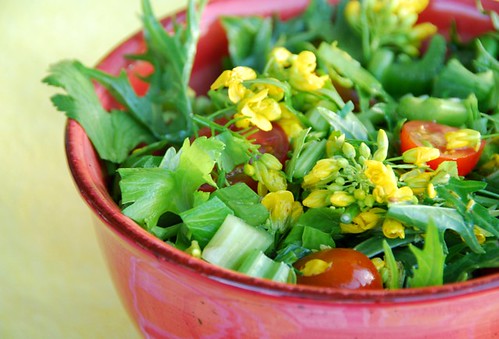
spicy mizuna and broccoli flower salad

Growing up "salad" meant a plate with iceberg lettuce, cucumber, carrot, and tomato slices, and bottled Catalina dressing.

Like TV's, salads have come a long way since then.

I remember in the 80's everyone started eating Caesar salad, and romaine bumped iceberg as the lettuce of choice. Then sometime in the '90s peppery salad leaves like arugula and radicchio were clandestinely added to salad plates. Back then people would disparagingly call them "the lettuce that bites you back." Ah, how things have changed.

Then came mesclun, and salad was never the same. Mesculn is a mix of tender, young salad leaves. Its name comes from the French mescla meaning "to mix." Mesclun varies depending on the source but may include arugula, mustard greens, oak leaf, radicchio, red beet greens, and sorrel.

The first time Jeff and I ate fresh mesclun from the farmers' market here in California we were taken aback:

"Wow! This salad has lots of flavor. You can really taste the greens," Jeff said.

Talking right over him, I exclaimed, "Is that a baby beet green?"

"Do you have these green pointy things in yours?" he replied, ignoring my question, "They're fantastic!" (Yes, we do get this excited over salad at my house.)

Turns out those green pointy things were mizuna. Mizuna is a Japanese mustard green with dark green, thin, serrated leaves, and a pleasantly spicy, peppery flavor. Though it has been cultivated in Japan since ancient times, it is believed to have originated in China. Most recipes for mizuna are Asian, and it features prominently in salads, soups, and stir-fries. It can be eaten raw or cooked, and it is packed with nutrients such as carotenes, folic acid, and vitamin C.

Mizuna is available at markets such as Whole Foods, and if you buy Trader Joe's herb salad mix, it's in there too. So you may have been eating mizuna without even realizing it.

Just when you thought you couldn't take any more salad excitement, I have to mention broccoli flowers. These tiny, yellow edible flowers have a robust flavor and beautify any salad. If you find them, don't hesitate to get them. They are sooo 2008.

I'm sending my mizuna salad to the always Well-Seasoned Cook, Susan, the host of this week's Weekend Werb Blogging created by Kalyn of Kalyn's Kitchen.
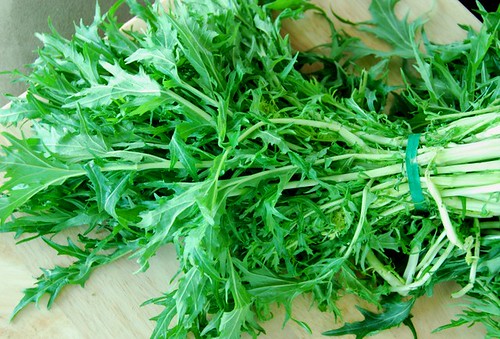
fresh mizuna

Mizuna and Broccoli Flower Salad
Serves 4
Print recipe only here.

Salad:
6-8 cups mizuna**
3-4 inner white stalks of celery with the leaves, thinly sliced on the diagonal
10-12 cherry or grape tomatoes, sliced in half
a handful of broccoli flowers, optional

Dressing:
1 tablespoon extra virgin olive oil
1 tablespoon rice wine vinegar
1 tablespoon fresh lime juice
1 tablespoon honey
the zest of 1/2 lime
6-8 cranks freshly ground black pepper
salt, to taste

Wash and pat dry the mizuna and place in a large bowl; add celery and tomatoes.

To make the dressing, whisk all ingredients in a small bowl. Add to salad; toss well to coat, then sprinkle with broccoli flowers, if using.

**Mizuna substitutions to consider: watercress, wild arugula, tender baby kale or mustard greens, tatsoi (another spicy Asian green that is usually available in markets such as Whole Foods.)

Other spicy green dishes you might like:


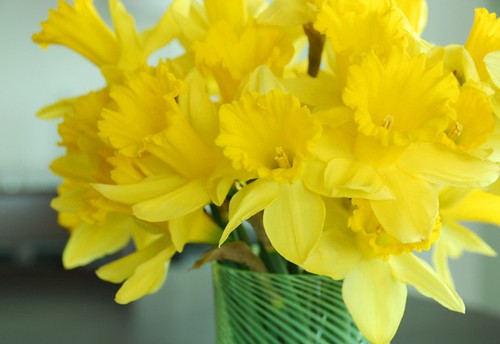
spring time daffodils

Speaking of Trader Joe's and yellow flowers, here is a bouquet of TJ's cheerful daffodils (unlike the broccoli flowers, I wouldn't eat them). After about 6 weeks, it's time to say good-bye to daffodils until next year. I hope Sandi likes daffodils since this is my entry for her Centerpiece of the Month.


Save This Page on Del.icio.us
Sunday, April 13, 2008

Beautiful Bones: An Osteoporosis Food Event

Since I started this blog in January 2007, I have shared a lot of things about myself. One thing I haven’t shared is that I have osteoporosis. According to the National Osteoporosis Foundation (NOF) osteoporosis is "a disease in which bones become fragile and more likely to break."

I’m not a senior citizen; that really is me in pictured to the right. But as I discovered last summer, you can be an otherwise totally healthy woman in her (let's say 30's) and still have osteoporosis.

Of the estimated 10 million Americans with osteoporosis, 8 million are women. In fact, osteoporosis is actually believed to be under-diagnosed which means there are likely many more women who are unknowingly afflicted with it. It is sometimes discovered by an astute internist (which is what happened to me) but unfortunately is often discovered after fracturing a bone (which happens to many women).

According to the NOF, there are many risk factors for osteoporosis in women, including:

  • Just being female
  • Missed periods (amenorrhea)
  • Low estrogen levels (especially during menopause)
  • Family history (especially mother and grandmother)
  • Being of a particular race/ethnicity such as Caucasian, Asian, or Latino, although African-Americans are also at risk
  • Low Body Mass Index (BMI) (being thin and small)
  • Lack of calcium and vitamin D, especially in childhood (this can be a real problem for lactose intolerant people)**
  • Lack of exercise
  • Smoking
  • Alcohol abuse
  • Certain conditions such as anorexia nervosa and asthma
** Amazingly, 90% of adult bone mass is acquired in girls by the age of 18! That means that after 18, you have only 10% of your bone mass that you can still build.

I have decided to host a food blogging event to alert women to the potential risks of osteoporosis and encourage them to take steps to protect their bones at every age. I am sure that I am not the only food blogga who has osteoporosis and was not aware of it.

Here’s the plan: May is National Osteoporosis Awareness Month which is the perfect time to hold an event. If you’d like to participate, then kindly follow these steps:

  1. Post one calcium-rich recipe on your blog any time between May 1st and May 31st. (Please no back dating or late entries.) And of course boy bloggas are welcome to participate.
  2. Include a link to this announcement.
  3. Email the following information to foodblogga [at] yahoo [dot] com, and mention beautiful bones in the subject line.
    • Your preferred name
    • Blog name
    • General geographic location
    • Your post URL and recipe name
  4. Please attach a 200 pixel image if you'd like an image to appear in the round-up.
  5. I would, of course, also appreciate your placing the event logo in your post.
No blog? No problem. Just email your preferred name, location, name of the recipe, and a 200 pixel image to foodblogga [at] yahoo [dot] com, and mention beautiful bones in the subject line.

The recipe can be for any type of dish you like as long as it contains at least one calcium-rich food as a main ingredient.

Calcium-rich foods:

  • Dairy products: all types of cheese, especially mozzarella and Parmesan, milk, soy milk, yogurt, soy protein or whey protein (for smoothies)
  • Soy: edamame, soy milk, tofu, tempeh, and other soy products
  • Nuts and seeds: all kinds, especially almonds and sesame seeds
  • Legumes: all kinds, especially black beans, black-eyed peas, and navy beans
  • Seafood: oysters, salmon, sardines, and shrimp
  • Green leafy vegetables: beet greens, collards, dandelion greens, kale, mustard greens, spinach, Swiss chard, turnip greens
  • Other vegetables: artichokes, asparagus, avocado, bok choy, broccoli, cabbage, carrots, celery, cremini mushrooms, fennel bulb, garlic, green beans, okra, potatoes, radishes, rhubarb, romaine lettuce, summer squash, tomatoes (yes, it's a fruit, but come on)
  • Fruits: bananas, blackberries, cantaloupe, grapes, kiwi, lemons, limes, oranges, strawberries, watermelon
  • Whole grains: (grains that are not milled) such as barley, cornmeal, oats, popcorn (no kidding!) quinoa, rice, rye, spelt, and whole wheat flour
  • Spices and herbs: black pepper, caraway seeds, cinnamon, coriander seeds, dill seed, parsley, oregano, poppy seeds, rosemary
  • Others: leavening agents, such as baking powder; corn tortillas; calcium fortified juices, breads, and dairy products
Meal ideas:

  • Breakfast: frittatas, granola, muffins, oatmeal, quick breads, scones
  • Lunch: burritos, salads, sandwiches, soups, stuffed potatoes, wraps
  • Dinner: pasta, pizza, grain dishes, seafood, stir-fries, tofu, vegetarian entrees
  • Appetizers/Snacks: bruschetta, crostini, cheese, dips, nuts, popcorn
  • Desserts: cakes, cookies, fresh fruits, ice cream, pies, puddings
  • Drinks: milkshakes, smoothies, yogurt drinks

During the month of May, I’ll write several posts for this event, sharing information about osteoporosis with you and providing a recipe with each post.

Please feel free to leave any questions or comments you may have in the comment box or email me directly at foodblogga [at] yahoo [dot] com. I'm looking forward to your bone-building, delicious submissions!

Logo was adapted from an image from the National Museum of Health and Medicine.

Thursday, April 10, 2008

A Fava Bean by Any Other Name Would Taste as Good

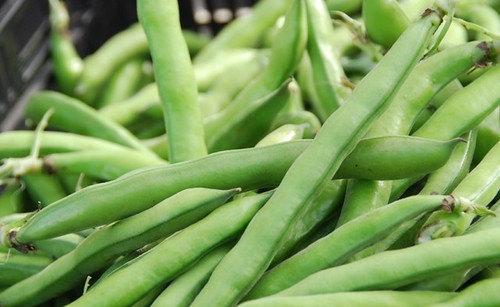
fava beans at the farmers' market

Finally, the wait is over! Fava beans are in season. They appeared for the first time last Sunday, and I couldn't be happier. I know how hard the wait has been on you too, but you can rest easy now. Well don't rest too easily. Fava beans have a depressingly short season--usually just 4-5 weeks in April-May.

Fava (FAH vah) beans, like artichokes, asparagus, and English peas are a hallmark of spring time produce. These meaty, chewy legumes are exceptionally flavorful; they're similar in taste to edamame and have the firm texture of lima/butter beans. In general, the larger the pod, the better the bean. So when you see them, buy them, even if they're $3.00-4.00/pound. You won't be disappointed.

And don't worry about what to call them. According to Wiki and Cook's Thesaurus, you're correct if you say Vicia faba, broad bean, butter bean, faba bean, English bean, field bean, horse bean, tic bean, or Winsdor bean. I'm not making this up. I think someone actually wrote a dissertation entitled "The Many Appellations of the Bean, Fava."

So call 'em whatever you want, just don't miss them. And follow these instructions for shelling. They take a little effort because you have to shell them twice, but trust me, they're worth it.
  1. Snap the top off of the pod. Sometimes the pod will split easily down the seam, but sometimes you have to squeeze and twist the pod with your fingers till it pops and the beans are exposed.
  2. Remove the beans and discard the shells.
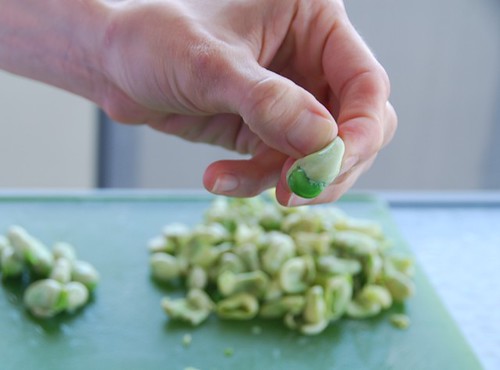
  3. Now you need to remove the waxy casing that encloses the fava bean. The easiest way is to boil the beans for 2 minutes, then drain them, and plunge in a bowl of ice water. Now for the fun part-- squeeze the casing gently between your thumb and forefinger and watch the fava bean pop out! Discard the waxy shell.

fava bean being shelled

Now it's time to eat them, and you can eat a lot of them. A 1/2 cup of boiled fava beans is just over 90 calories and contains nearly 7 grams of protein and 5 grams of dietary fiber. They're high in calcium, iron, and folate. So enjoy them in salads, soups, pastas, and risottos. Or mash 'em up in spreads and dips.

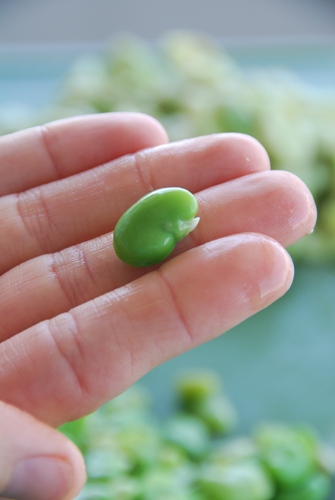
fava bean in my hand

I'm sending this recipe to Jai and Bee of Jugalbandi, the hosts of this week's Weekend Herb Blogging created by Kalyn of Kalyn's Kitchen.

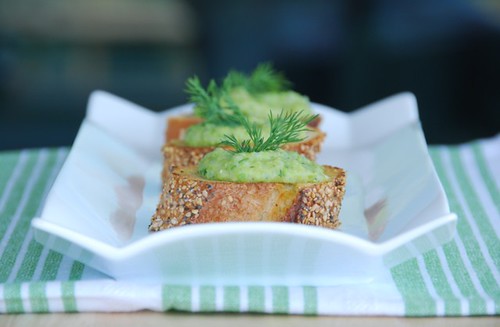
fava bean and dill crostini

Fava Bean and Dill Crostini
Yields 3/4-1 cup
Print recipe only here.

3/4 cup shelled fava beans (about 1-1 1/4 pounds fresh fava beans in the shell)
1/2 cup red potato, diced
1 tablespoon plus 1 teaspoon Meyer lemon juice
1 tablespoon extra virgin olive oil
7-8 cranks black pepper
3 tablespoons fresh minced dill
2 tablespoons grated Reggiano-Parmigiano cheese
4 tablespoons water, or as needed
salt, to taste

1 baguette

Boil the fava beans in a small pot for 2-3 minutes; drain, and plunge into a bowl of ice water.

Meanwhile in a small pot, boil potatoes for 10 minutes, or until tender when pierced with a fork. Drain and let cool. Squeeze the casing gently between your thumb and forefinger and watch the fava bean pop out! Discard the waxy shells.

Place fava beans, potatoes, and remaining ingredients in a food processor and process until smooth. Use less water for a chunkier spread and more water for a smoother spread.

Toast bread slices. Spread bean mixture on toasts. Sprinkle with some sea salt, drizzle with some extra virgin oil oil, and top each with a sprig of fresh dill.

Note: If you can't find fava beans, then I suggest substituting lima/butter beans or edamame. I have also made this spread with fresh shelled English peas and fresh shelled sugar snap peas which are equally delicious.

You might also like:

Save This Page on Del.icio.us

Monday, April 7, 2008

Habaneros Are Hot

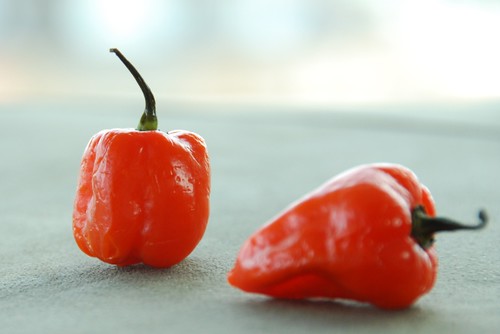
habaneros

In August 1997, and Jeff and I were at the Raleigh Farmers' Market in North Carolina. A farmer was selling a wide variety of chilies, including habaneros. I was instantly drawn to their shiny, reddish-orange skin and almost heart-like shape.

"What do habaneros taste like? I asked.

"They got kick in 'em," he said, as he chewed on a toothpick.

"Can they be eaten raw, or should I cook them?" I asked.

"You can eat 'em any way you like," he said, now twirling the toothpick between his thumb and forefinger.

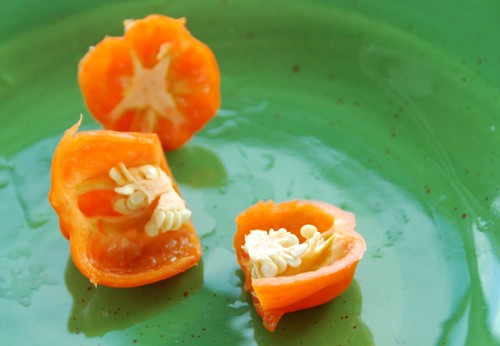
"How 'bout the seeds? Should I take them out first?" I asked.

habanero seeds

"If you want to," he said.

Realizing I was just going to have to find out for myself, I quickly selected four or five brilliant habaneros, paid for them, and proudly announced to Jeff that I would make burritos with habanero salsa for dinner.

As I was preparing the salsa, Jeff sampled a tiny piece of the habanero; he coughed a couple of times and declared it "pretty hot." I decided to forgo the taste test and chopped up two habaneros, seeds and all.

We sat down to eat dinner, and I added a spoonful of my brilliant orange habanero salsa to my burrito. After the first bite, I felt a burning sensation on my lips, then my tongue started to prick with heat. Within seconds, actual flames of fire were leaping through the roof of my mouth into my nose. I tried to yelp but only gurgling sounds came out.

Jeff, realizing I was in trouble, handed me a glass of water. (This was before medical school; what did he know?) I waited for relief. Instead, like throwing water on hot oil, the fire in my mouth roared.

After a couple minutes of coughing and chest pounding, I said to Jeff, "My lipth feelths funny." I went into the bathroom and sure enough, my upper lip was swollen to twice its size. I'd always wanted fuller lips but this was ridiculous.

I've learned a few things about chilies since that memorable day. Turns out a chili's "heat" comes from a compound called capsaicin and can be measured on the Scoville Scale. Created by a chemist named Wilbur Scoville, this scale accurately measures the level of capsaicin in a chili. Scoville heat units (SHU) indicate the amount of capsaicin in a chili. For instance,
  • a red bell pepper registers a zero (you feel nothing)
  • a jalapeno = 2,500-8,000 (you feel a mild tingling sensation in your mouth)
  • a serrano = 10,000-25,000 (your lips and belly get warm and prick with heat)
  • a habanero = 100,000-350,000 (pain, not enjoyment, pain)
The Wall Street Journal not too long had a story on the world's hottest chili, the bhut jolokia, which registers over 1,000,000 SHU! At that heat, I would be afraid of dying.

Despite my initial adverse reaction, I still eat habaneros but without the seeds. And if my mouth starts to burn, I don't drink water. I eat bread or a banana; I've read that creamy foods like yogurt are supposed to work too.

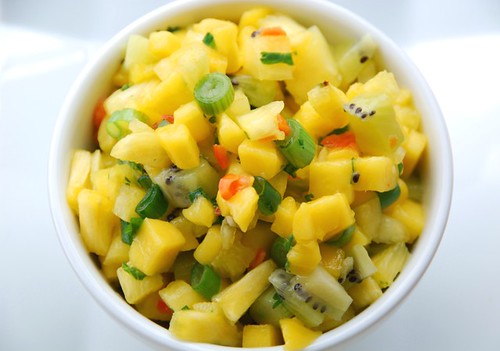
habanero salsa bowl

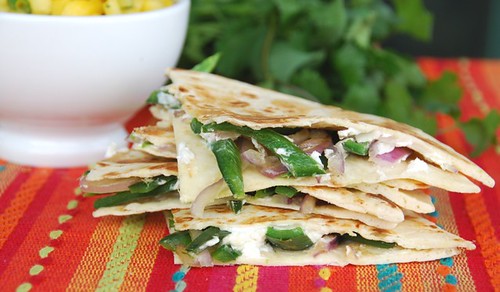
So please try these quesadillas with a fruity habanero salsa. The sweet pineapple, mango, and kiwi contrast pleasingly with the spicy green onions and fiery habanero. Plus the acidic lime juice helps to temper the chili's heat. It's a quick mid-week meal or easy party dish. Feel free to play around with the ingredients to your liking; after all, quesadillas are meant to be fun.

When you make them, just be sure to have some bread, bananas, and yogurt nearby, just in case.

quesadilla close up

Goat Cheese and Poblano Quesadillas with Pineapple-Mango-Habanero Salsa

Make 4 quesadillas
Print recipe only here.

Salsa:
1 cup diced fresh pineapple
1 cup diced fresh mango
1 diced kiwi
1 habanero, minced, and seeds removed (unless you're a glutton for punishment)
2 green onions, thinly sliced
the juice of 1 lime
1 tablespoon minced fresh cilantro
salt, to taste

Quesadillas:
1 large or 2 small poblano peppers, de-seeded and thinly sliced
1 teaspoon canola oil
1 medium red onion, thinly sliced
1 teaspoon sugar
salt, to taste

8 (6-7- inch flour tortillas)
4 ounces goat cheese

To prepare the salsa, place all ingredients in a medium bowl and gently toss. Allow to rest for at least 30 minutes (or up to 2 hours) for the flavors to mingle.

Place poblano pepper over an open gas flame, turning occasionally, until thoroughly charred and blistered on all sides. Wrap tightly in aluminum foil and let rest for 15 to 20 minutes. Remove, and using some paper towel, gently scrape off the skin. Halve, stem and seed the pepper. Cut into strips, then dice, and place in a bowl. Set aside.

Heat a medium nonstick skillet over medium heat. Add canola oil and red onion, and saute for 3-5 minutes. Add sugar, reduce heat to low, and continue to cook until onions are caramelized, about 7-10 minutes. Add cooked poblano peppers to the skillet, season with salt, and toss to combine. Remove from heat.

Place 1 tortilla on a clean cutting board; spread with 1 ounce of goat cheese, then 1/4 of the poblano mixture. Top with another tortilla, and press lightly with your hand. Continue with remaining tortillas and filling until you complete 4 quesadillas.

Heat a large, nonstick, dry skillet over medium heat. Add 1 quesadilla. Cook until lightly browned, about 2 minutes per side. Transfer to a baking sheet and place in a warm oven (200-300 degrees F) until ready to serve. (Or eat 'em as you make 'em.) Repeat with remaining 3 quesadillas.

Cut each quesadilla into 3 or 4 wedges. Serve with salsa.

You might also like:

Note: The previous post for WEB, Weekend Eagle Blogging was a spoof. Please don't send me pictures of predatory birds with road-kill soup.


Save This Page on Del.icio.us

Friday, April 4, 2008

Weekend Eagle Blogging Week 1: Apple, Fennel, and Celery Salad

The story of how W.E.B. began:

A couple of weekends ago while I was making lunch, Jeff suddenly froze at the computer. In an intense whisper, he said: "Sue, there's an eagle on our windowsill." "Yeah, right," I responded, and continued slicing my fennel.

The next thing I knew, Jeff s-l-o-w-l-y slithered out of his chair and grabbed the camera. So I dropped my chef's knife and walked to the window. "OH MY GOD! There's an eagle on our windowsill!" I exclaimed. "I know, that's what I tried to tell you!" he said.

Jeff made it to our deck and started snapping pictures of this fiercely beautiful creature. We were mesmerized; it's not too often you see an eagle on your windowsill. After several minutes, he took off, and we went inside to eat our lunch, which included this apple, fennel, and celery salad. Which is when this brilliant idea hit me.

For months now, I have been holding back. Well, no more. I am frankly quite tired of the whole weekend cat blogging scene. Having never had a cat nor met a cat I particularly liked (or that liked me), I have always felt left out on Saturdays. I think I might have been a dog in a former life or something, because every time I encounter a cat, it stops in its tracks and stares me right in the eyes -- like it knows my secret or something. Even in pictures on the web, they are staring at me.

Every Saturday as I troll through my reader, I jump when a cat picture pops up. I have found myself now avoiding the whole Saturday scene. So here's my idea. For all you non-cat girls (and guys) like me who slump on the sofa on Saturdays, ostracized by the cat community, I'm starting W.E.B. (Weekend Eagle Blogging). Send me your most adorable shots of Tabby or Fluffy the eagle eating a rodent or picking road kill out its talons, and I'll post it. Oh yeah, this is gonna be big.

eagle turning

eagle stare
"I likes to eats weekend catz."

eagle down
"I seez raisins on that apple fennel salad."

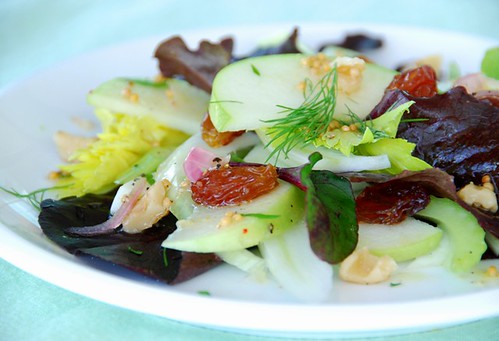
apple, fennel, and celery salad

This salad is like a farewell to winter and a hello to spring: winter's tart Granny Smith apples get a lift from the season's new crop of licorice-laced fennel and fresh dill. Topping it off with plump, chewy raisins makes it even sweeter. It's a satisfying salad of complex textures and flavors that is sure to please (even if you don't have any eagles to admire while you eat it).

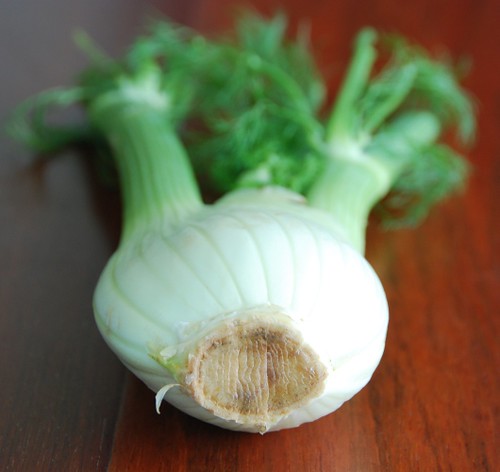
fennel bulb

Since I never feel left out of Weekend Herb Blogging, I'm sending my salad to this week's host and creator of WHB, the always kind Kalyn of Kalyn's Kitchen.

In addition to being an aphrodisiac, mildly licorice-flavored fennel is low in calories and nutritious. One cup of sliced fennel is only 27 calories and has a mere 6 grams of carbohydrates. Yet it provides 17% of your daily recommended allowance of vitamin C. It's currently in season and is exceptionally flavorful, so it's the perfect time to try it.

Apple, Fennel, and Celery Salad

Makes 4 servings
Print recipe only here.

Vinaigrette:
1 teaspoon yellow mustard seeds
1 shallot, sliced
1 tablespoon, plus 1 teaspoon extra virgin olive oil
2 teaspoons rice vinegar
2 teaspoons Dijon mustard
1 tablespoon, plus 1 teaspoon honey
2 tablespoons fresh Meyer lemon juice**
3-4 tablespoons water
2 teaspoons fresh parsley, chopped
2 teaspoons fresh dill, chopped
Salt and black pepper, to taste

Salad:
8 cups spicy mesclun greens
1 large Granny Smith apple, thinly sliced
2 tablespoons Meyer lemon juice**
1 medium fennel bulb, thinly sliced
2 inner celery stalks, sliced on the diagonal, with some leaves
2 tablespoons crimson or golden raisins
2 tablespoons toasted walnuts

Optional garnishes:
fennel fronds, fresh dill, toasted nuts, such as almonds, chestnuts, pecans, or pistachios

To toast the walnuts, place in a small, dry skillet over medium heat for 1-2 minutes, until golden brown and aromatic. Set aside.

To make the vinaigrette, place mustard seeds in a small, dry skillet over medium heat; toast for 1-2 minutes until they begin to pop; set aside. In the same skillet, sauté shallots in olive oil; whisk in remaining vinaigrette ingredients. Turn off heat.

For the salad, place apple and fennel slices in a bowl with fresh lemon juice and toss to prevent them from turning brown. Pour out lemon juice before adding to salad.

In a large bowl, add mesclun, apple and fennel slices, and celery; add vinaigrette, and toss until well coated. Divide among 4 plates. Garnish with raisins and walnuts.

**If you can't find Meyer lemons, then regular lemons are fine.

You might like these other recipes featuring fennel:

**Update: OK, OK, so it's not an eagle; it's a hawk. But WHB was already taken.

Save This Page on Del.icio.us

Monday, March 31, 2008

Savory Sausage and Fennel Galette and My New Best Friend

I have a new friend I'd like you to meet. I've never had a friend like her before-- she's fast and easy. So I was skeptical when my parents, of all people, insisted I would like her.

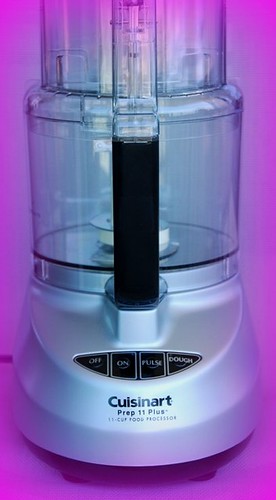
I don't like her, I love her. Readers meet Miss Cuisinart.
Cuisinart food processor

She is now my new best friend. Pie crusts (see ricotta pie and rice pie) are a snap thanks to her. She's also really neat; I no longer have to suffer sticky fingers and counter tops; she keeps everything to herself.

In full disclosure, our relationship was a bit bumpy at first. I wasn't sure when her dough needed more water or was ready to come out, and she wasn't forthright with me. So last time my mom visited, she conducted an intervention between Miss C. and me. Mom gave me suggestions such as how much water to add and how much to pulse. She did not give Miss C. any suggestions though; I guess I was the source of all our problems.

After that, Miss C. and I made pate brisee, a French buttery crust that is wonderful for pies and tarts. We also made a basic sweet pie crust for strawberry pie (coming soon). I was so elated at this turn of events, I would have kept making more crusts, but how many pies can two people eat?

Though Miss C. and I are tight now, I still won't invite her over when I make homemade pizza dough. Pizza dough is always made by hand; I'm just old school that way.

If you're looking for a new friend to hang out with in the kitchen, Miss C. has lots of sisters; you can find them at the Cuisinart site. So go ahead and splurge. OK, maybe not on the $800 one, (we are in a recession after all) but perhaps on the $150 or $200 model. She'll be one of the most reliable friends you've ever had.

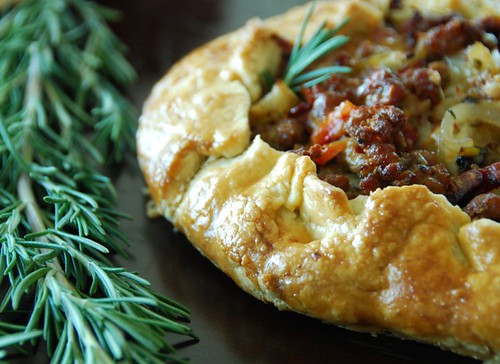
savory sausage, fennel, and sun-dried tomato galette

My pate brisee (from Martha Stewart's Baking Handbook) is the basis of this savory galette. A galette, which I like to call the "Lazy Susan's Pie," is an open-faced, free form pie that can be filled with savory or sweet fillings. Think of galettes as low maintenance pies-- they don't have to look perfect; a few little cracks are "rustic."

I made a savory filling of hot Italian sausage, crisp fresh fennel, salty sun-dried tomatoes, and rich smoked mozzarella. Though the aroma will entice you to eat two or three pieces, I'd suggest just one; the crust is rich, and buttery, and the filling is, well, filling. Serve it as an appetizer or with a simple side salad of arugula and cherry tomatoes for a dinner.

Savory Sausage and Fennel Galette
Serves 6-8
Print recipe only here.

Pate Brisee: (from Martha Stewart's Baking Handbook)
1 1/4 cups all-purpose flour
1/2 teaspoon salt
1 stick unsalted butter, cold, cut into small pieces
1/8 cup ice water, plus more if needed

Filling:
(from Food Blogga)
2 tablespoons olive oil, divided
1 medium onion, thinly sliced
1 pound hot fennel sausage, removed from the casing
1 medium fennel bulb, thinly sliced
2 teaspoons sugar
6 sun-dried tomatoes, soaked in oil, patted dry and thinly sliced
1 cup shredded smoked mozzarella
1/4 cup chopped fresh sage
1/4 cup chopped fresh rosemary

1 egg, lightly beaten, and 1/2 teaspoon water for egg wash

In the bowl of a food processor, combine flour and salt; pulse to combine. Add the butter, and pulse until mixture coarse crumbs with some larger pieces remaining, about 10 seconds. (To mix by hand, combine dry ingredients in a large mixing bowl, then cut in butter with a pastry blender.)

With the machine running, add the ice water through the feed tube in a a slow, steady stream, just until dough holds together without being wet or sticky. Do not process more than 30 seconds. Test by squeezing a small amount of the dough together; if it is still too crumbly, add a bit more water, 1 tablespoon at a time.

Turn out the dough onto a clean work surface. Divide in half, and place each half a piece of plastic wrap. Shape into flattened disks. Wrap in plastic, and refrigerate at least 1 hour or overnight. (The dough can be frozen for up to 1 month; thaw overnight in the refrigerator before using.)

To make the filling, warm olive oil in a large skillet over medium-high heat. Add onions and sausage, stirring occasionally until lightly browned, about 3-4 minutes. Add sliced fennel and sugar, and continue sauteing until sausage is cooked through and vegetables are lightly browned, another 3-4 minutes. Add sun-dried tomatoes, and cook for 1-2 minutes. Turn off heat, and stir in smoked mozzarella and fresh herbs, until well combined.

On a lightly floured surface, roll out the dough to a 12-inch round, about 1/8 inch thick. Transfer dough to a large parchment-lined baking sheet. Refrigerate until ready to use, up to 1 hour. Meanwhile, preheat the oven to 375 degrees F.

Arrange filling on top of dough, leaving a 2-inch border all the way around. Fold the border over the filling, overlapping where necessary and pressing gently to adhere the folds.

Brush dough with egg wash. Bake for 35-45 minutes, or until crust is golden brown and the filing is crispy. Transfer the baking sheet to a wire rack to cool the galette. Serve warm or at room temperature.

(The second piece of dough can be frozen for up to 1 month; thaw overnight in the refrigerator before using.)

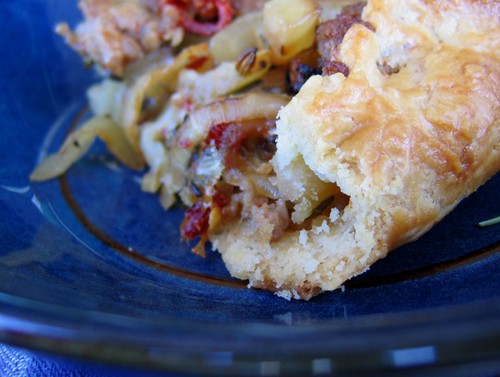
savory galette slice

You might also like:

Save This Page on Del.icio.us
Thursday, March 27, 2008

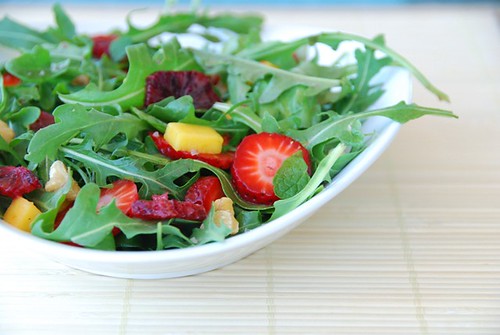
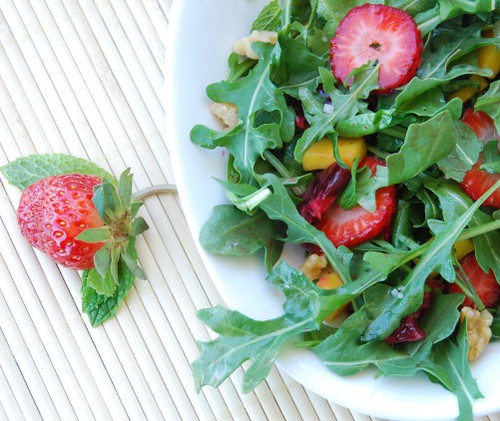
Seductive Strawberry Salad

seductive strawberry salad

Think a salad can't be seductive? Think again.

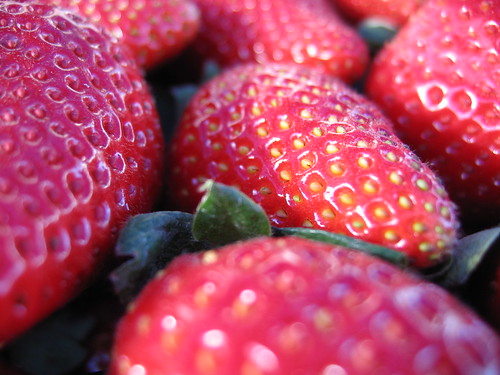
strawberries at the farmers' market

Seductive Strawberry Salad
Makes 4 servings.
Print recipe only here.

Salad:
4 cups wild arugula
3 cups baby spinach
2 medium blood oranges, peeled and sectioned (about 1 cup)
10-12 fresh strawberries, hulled and sliced (about 1 cup)
1 medium mango, diced (about 1 cup)
1 tablespoon thinly sliced fresh mint leaves
1 tablespoon thinly sliced fresh basil leaves
2 tablespoons toasted nuts (such as pistachios, pecans, or walnuts)

Vinaigrette:
1 tablespoon extra-virgin olive oil
1 tablespoon white balsamic vinegar
1 tablespoon fresh Meyer lemon juice (or regular lemon)
2 tablespoons freshly squeezed blood orange juice
1/4 teaspoon grated lemon zest
Salt and pepper, to taste

To toast the nuts, place them in a small, dry skillet over medium heat. Shake the pan handle back and forth for 1-2 minutes, or until the nuts are golden brown and aromatic. Set aside.

In a large bowl, gently toss all salad ingredients (excluding nuts).

In a small bowl, whisk all vinaigrette ingredients until well combined. Pour over salad and toss gently until well coated. Divide the salad among four plates and sprinkle with nuts.

seductive strawberry salad

I hope Mike of Mike's Table likes fruit in his salad because I'm sending this to him for his Strawberry Seduction event.

You might also like these fruity salads:


Save This Page on Del.icio.us